Yes, buy travel insurance for your vacation rental if any part of the booking is prepaid and nonrefundable, or if you want protection for the security deposit. The right policy reimburses your rental costs if you have to cancel or cut the trip short, and with a damage or security-deposit upgrade, it can also cover a broken lamp, a stained rug, or a host who withholds your deposit over a dispute you didn’t cause.
Here’s the shortlist to start with:
- Balanced coverage with rental add-ons: Travel Guard’s tiered plans (Travel Light, Travel Care, Travel Secure) bundle trip cancellation, lockout assistance, and optional upgrades.
- Security-deposit protection: Travelex’s Advantage and Ultimate tiers include a deposit upgrade with a stated reimbursement cap.
- High cancellation limits and CFAR: Trawick International’s Stay Secure Vacation Rental Protection markets some of the highest trip-cancellation ceilings in the category.
- Buy-while-traveling flexibility: World Nomads lets many travelers purchase coverage after departure, useful if you booked a last-minute rental.
Buy within 14 to 21 days of your first trip payment if you want a pre-existing medical condition waiver or Cancel-For-Any-Reason (CFAR) eligibility. Miss that window and you’ll likely lose both options, even if the rest of the policy still applies.
Pro Tip: Skip the security-deposit upgrade only if your host uses a verified platform-based deposit system with clear documentation. If the host collects a deposit by check, Venmo, or wire transfer outside a booking platform, add the upgrade.
Key Takeaways
Buying rental-focused travel insurance protects your prepaid vacation-rental costs, but only a damage or security-deposit upgrade protects you against host disputes over accidental property damage.
| Point | Details |
|---|---|
| Buy if nonrefundable | Purchase coverage whenever your rental has a strict cancellation deadline or full prepayment requirement. |
| Check damage limits explicitly | Confirm the dollar cap for security-deposit and damage coverage before assuming it’s included. |
| Add CFAR within the window | Buy Cancel-For-Any-Reason within 14 to 21 days of your first deposit if your travel dates are uncertain. |
| Save the host’s cancellation policy | Screenshot the exact refund terms at booking; it’s the document every claim eventually needs. |
| Book through a transparent provider | Rentalsinstgeorgeutah publishes clear cancellation terms and amenities upfront, making it easier to insure your stay accurately. |
Table of Contents
- Comparing Travel Insurance for Vacation Rentals Side by Side
- What Does Vacation Rental Travel Insurance Actually Cover?
- How Do Rental-Damage and Security-Deposit Upgrades Actually Work?
- What Does Travel Insurance for a Vacation Rental Cost?
- How Do You Choose the Right Policy for Your Rental?
- How Do You File a Claim if Something Goes Wrong?
- The Coverage Gaps That Cause Denied Claims
- How I Actually Pick a Policy for My Own Rental Stays
- Where Rentalsinstgeorgeutah Fits Into Your Travel Insurance Plans
- Sources
- FAQ
Comparing Travel Insurance for Vacation Rentals Side by Side
The plans below differ most on three things: whether they cover rental damage or security deposits, how much cancellation protection they offer, and whether CFAR is on the table. Here’s how the major players stack up.
A few things jump out once you line these up. Trawick International’s Stay Secure plan advertises cancellation limits as high as $200,000, which matters if you’ve booked a large group home for a wedding or reunion where the total prepaid cost is steep. Travelex builds its security-deposit upgrade directly into the product with a stated dollar cap, so you know exactly what you’re buying rather than guessing at sub-limits buried in a certificate of insurance.
If your priority is flexibility over hard numbers, World Nomads stands out because it lets many travelers buy coverage for vacation rentals even after they’ve already left home. That’s a real advantage if your rental plans firm up close to departure. For budget-conscious travelers with a refundable booking, a lighter-tier plan without CFAR or a damage upgrade often makes more sense than paying for coverage you won’t use.
What Does Vacation Rental Travel Insurance Actually Cover?
Vacation rental travel insurance reimburses the money you’ve already put down for a private home, condo, or villa if a covered reason forces you to cancel, cut the trip short, or deal with a medical emergency while there. It is a distinct product from homeowner or landlord insurance, which protects the property owner’s structure and liability, not your prepaid booking or your belongings.
The core benefits look similar across most policies:
- Trip cancellation: reimburses nonrefundable rental costs if you cancel for a covered reason before departure.
- Trip interruption: covers costs if you have to leave the rental early, often reimbursing unused nights.
- Emergency medical and evacuation: pays for treatment and transport if you get sick or hurt during the stay.
- Baggage and personal effects: covers lost, stolen, or damaged luggage and belongings.
Rental-specific features are where these plans earn their keep. Travel Guard’s vacation-rental plans include rental-home lockout assistance and a trip-exchange benefit that lets you rebook a different property if your original one falls through, alongside standard 24/7 emergency assistance. Vacationrentalinsurance directly into its higher-tier Travel Secure and Travel Care plans, with example benefit amounts published on the plan pages rather than hidden in fine print.
| Coverage Type | What It Reimburses | Typical Tier Placement |
|---|---|---|
| Trip cancellation | Prepaid, nonrefundable rental cost if you cancel for a covered reason | All tiers, higher limits on premium plans |
| Trip interruption | Unused nights and return-transport costs if you leave early | All tiers |
| Security deposit/damage upgrade | Reimbursement for accidental damage or withheld deposit | Add-on or higher tiers only |
| Rental-home lockout | Locksmith or replacement-key costs | Select plans |
| Emergency medical | Treatment costs during the stay | All tiers, limits vary |
Policy wording usually draws a sharp line between “security deposit reimbursement” and “host chargeback disputes.” If your host simply refuses to return a deposit without documenting damage, some insurers treat that as a contractual dispute rather than a covered loss.
Pro Tip: Read the exact phrase your policy uses for deposit coverage. “Reimbursement of security deposit withheld due to accidental damage” is very different from “reimbursement of security deposit,” and the difference decides whether a petty host dispute gets paid.
How Do Rental-Damage and Security-Deposit Upgrades Actually Work?
These upgrades reimburse you, the guest, not the host. If you damage something in the rental, you typically pay the host directly (or the host deducts it from your deposit), then you file a claim with your insurer for reimbursement up to the policy’s stated limit. This is fundamentally different from how a homeowner’s landlord policy works.
A few mechanics matter more than most travelers realize:
- Sub-limits apply. A $2,000 total trip-cancellation benefit doesn’t mean $2,000 for a broken television; damage upgrades often carry their own smaller cap.
- Per-event caps are common. Some policies pay per incident, others cap total damage payouts for the entire trip.
- Intentional damage is excluded everywhere. No policy reimburses damage caused by parties, house-rule violations, or reckless behavior.
- Documentation timing matters. Insurers generally want damage reported and photographed before you leave the property, not after you’re already home.
Red flags to watch for including vague policy language (“coverage for property damage may apply”) instead of a stated dollar limit, and damage upgrades that cap out well below what a single broken appliance or stained carpet would cost to replace.
Pro Tip: Claims adjusters almost always ask for time-stamped photos of the damage and the host’s itemized invoice. Take photos of the entire rental at check-in, before you unpack, so you have a clear “before” record if a dispute ever comes up.

What Does Travel Insurance for a Vacation Rental Cost?
Expect to pay somewhere in the range of 4% to 10% of your total trip cost for a rental-focused plan, with the wide range driven mostly by your age, trip value, and whether you add CFAR or a damage upgrade. Travel Guard estimates typical travel insurance premiums fall around 5% to 7% of trip cost, which lines up with what most travelers see across comparable plans.
| Trip Cost | Estimated Premium (Standard Plan) | Estimated Premium (With CFAR/Damage Upgrade) |
|---|---|---|
| $2,000 | $100 | $160 |
| $5,000 | $250 | $400 |
| $10,000 | $500 | $800 |
These are estimates based on published percentage ranges, not quotes from a specific insurer, so treat them as a starting point for budgeting rather than a guaranteed price. What actually moves your premium:
- Trip cost. Higher prepaid rental costs mean higher premiums, since the payout ceiling scales with what you’re insuring.
- Traveler age. Older travelers typically pay more for the same coverage, largely due to medical-benefit pricing.
- CFAR add-on. Cancel-For-Any-Reason typically adds 40% to 60% to the base premium and usually requires purchase within 14 to 21 days of your first trip deposit.
- Damage or security-deposit upgrade. A modest add-on cost, but one that’s easy to skip if you’re not paying close attention while comparing quotes.
- Purchase window. Buying late can mean losing eligibility for CFAR or the pre-existing condition waiver entirely, regardless of how much you’re willing to pay.
CFAR also isn’t available everywhere. Some states restrict CFAR sales or require it be purchased alongside a standard cancellation plan rather than as a standalone rider, so confirm availability for your state before assuming it’s an option.
How Do You Choose the Right Policy for Your Rental?
Start with four questions before you compare a single quote: How much is nonrefundable if I cancel? Does the host’s cancellation policy already protect part of my payment? Do I need CFAR, or does a standard covered-reason list handle my risk? And how much would I actually lose if the property had accidental damage during my stay?
Run every plan you’re considering through this checklist:
- Confirm the rental-damage or security-deposit limit. Get the exact dollar figure, not a vague “coverage may apply” statement.
- Check CFAR rules. Confirm the purchase window, the percentage reimbursed (usually 50% to 75%, not 100%), and any state restrictions.
- Verify medical and evacuation limits. International trips especially need evacuation coverage in the six-figure range.
- Ask about the pre-existing condition waiver. Confirm the exact number of days after your first payment you have to buy the policy.
- Test the claims process before you need it. Call the insurer’s line once and see how long it takes to reach a person.
Questions worth asking an agent directly: Who do I contact first if something goes wrong, the insurer or the host? What documentation do you require for a damage claim? Is the security deposit reimbursed to me or paid directly to the host?
Red flags that should make you look elsewhere: a damage limit that’s suspiciously low relative to the rental’s value, no clear 24/7 assistance number listed anywhere on the policy documents, and a claims process that requires mailing physical paperwork with no online option.
Pro Tip: At booking, save a screenshot or PDF of your host’s exact cancellation and refund policy. This single document is the fastest way to prove what you’d lose if you have to cancel, and adjusters ask for it constantly.
How Do You File a Claim if Something Goes Wrong?
Start with the insurer’s 24/7 emergency assistance line the moment something happens, not after you get home. That single call can arrange medical care, coordinate transport, or connect you with a locksmith if you’re locked out, and it starts the documentation trail your claim will eventually need.
- Contact emergency assistance immediately for medical issues, theft, or major property damage.
- Notify the host and local authorities if there’s theft or significant damage, and get a police report where relevant.
- Photograph everything before you clean up or leave, including the damage, the surrounding area, and any host communication about it.
- Collect documentation: the host’s damage invoice, your booking confirmation showing prepaid costs, receipts for any out-of-pocket expenses, and medical records if applicable.
- Submit your claim promptly. Most insurers set deadlines from 20 to 90 days after the incident, so don’t let paperwork sit.
- Keep every receipt, even small ones, since insurers reimburse based on documented expenses, not estimates.
- Escalate if denied. Ask for the specific policy clause cited in a denial and request a supervisor review if the reasoning seems off.
The 24/7 assistance line matters more than most travelers expect. It’s not just a claims hotline; it typically coordinates real-time help, arranging a replacement rental if yours becomes uninhabitable, connecting you with local medical providers, or handling a locksmith call at 2 a.m. when you’re locked out of a rental in an unfamiliar town.
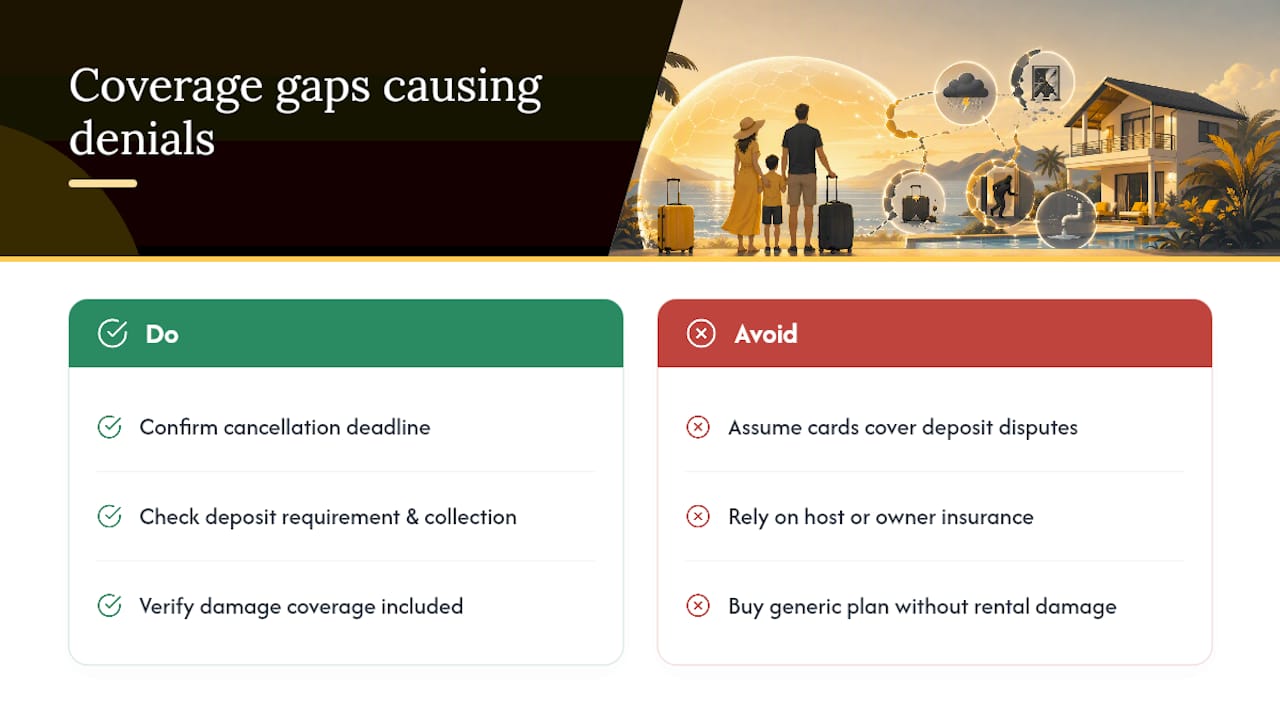
The Coverage Gaps That Cause Denied Claims
The single biggest mistake travelers make is assuming a credit card or the host’s own protections already cover a canceled rental or a withheld deposit. Credit card travel protections typically only apply to purchases made on that specific card, and even then, they rarely cover security-deposit disputes. If a host keeps your deposit over disputed damage, your card issuer usually won’t get involved at all.
The second mistake is buying a generic travel plan without checking whether it includes rental-damage coverage or CFAR, then discovering the rental’s cancellation policy was nonrefundable the whole time. Private rental hosts frequently set stricter terms than hotels: many require full payment 30 to 60 days out with zero refund after that point.
It’s also worth understanding why owner-side insurance won’t help you as a guest. Property owners typically need dedicated short-term-rental or commercial policies, since standard homeowners and landlord insurance often excludes short-term rental use entirely. Specialized owner programs cover the owner’s liability and lost rental income, not your prepaid trip cost or your belongings. Some commercial vacation-rental programs even carve out guest-caused property damage as a separate line item, which underscores that this is the owner’s protection, not yours. Renting out a property for income is treated as a business activity by industry groups like USTIA, which is exactly why the coverage gap between owner policies and traveler policies exists in the first place.
Pro Tip: Before you book or buy, confirm three things: the rental’s exact cancellation deadline, whether the host requires a security deposit and how it’s collected, and whether your travel insurance plan’s damage coverage is an included benefit or a paid add-on.
How I Actually Pick a Policy for My Own Rental Stays
Most guides treat travel insurance as a single yes-or-no decision. It isn’t. The real decision is how much of your trip cost is actually at risk, and that number should drive every other choice you make.
For a budget weekend rental under $1,500 with a flexible cancellation policy, I skip CFAR entirely and buy a light plan with basic trip-interruption and medical coverage. The math doesn’t favor an expensive add-on when the host would refund most of the booking anyway. But for a family trip in the $5,000 to $10,000 range, especially one booked five or six months out, I always add the security-deposit upgrade and seriously consider CFAR if the trip falls during a season with real weather risk. The upgrade cost is small relative to what a single stained sofa or a canceled trip during hurricane season would cost me out of pocket.
The habit that’s saved me the most hassle isn’t a policy feature at all. It’s photographing the entire rental within the first ten minutes of arrival, before bags are even unpacked. That one habit has resolved every damage disagreement I’ve ever had with a host in about two text messages, because there’s no argument about what was already broken versus what happened during the stay.
What I actually prioritize when comparing plans: a clearly stated damage limit over a vague one, a 24/7 assistance line I can test before I need it, and claims documentation requirements that are spelled out upfront rather than discovered after a denial.
Where Rentalsinstgeorgeutah Fits Into Your Travel Insurance Plans
Travel insurance protects your money if the trip goes sideways. Rentalsinstgeorgeutah handles the other half of the equation: making sure the rental itself is the kind of place where things are far less likely to go sideways in the first place. This is not a substitute for the plans compared above. It’s what you’re actually insuring.

Every property listed through Rentalsinstgeorgeutah comes with clear amenities, transparent booking terms, and dedicated customer support, so you know exactly what you’re paying for before you ever need to file a claim. That matters more than it sounds. A host cancellation policy you can actually read and understand at booking is the exact document your insurer will ask for if you ever cancel, and Rentalsinstgeorgeutah’s customizable stay options make that policy straightforward from the start rather than something you have to dig for later.
If you’re planning a stay near Zion National Park or anywhere in southern Utah’s red rock country, browse available vacation homes in St. George and check current dates before you lock in your insurance quote. Knowing your exact prepaid total and cancellation terms upfront makes comparing coverage options far easier, and booking with a rental provider that documents those terms clearly is the first real step toward a trip with fewer surprises.
Sources
Read the actual plan documents before purchasing, not just the marketing page. Look specifically for the stated damage or security-deposit limit, the exact CFAR purchase window, and the pre-existing condition waiver terms.
- Vacation Rental Insurance Plans | Travel Guard
- Get vacation rental travel insurance with trip cancellation coverage
- Vacation Rental Insurance for Renters, Plus Damage Protection
- Travel insurance for vacation rentals
FAQ
What Kind of Insurance Do I Need for a Vacation Rental?
You need a travel insurance plan with trip cancellation and interruption coverage, plus a rental-damage or security-deposit upgrade if your host collects a deposit. A standard hotel-focused policy often skips the damage-protection piece entirely.
Does AAA or AARP Offer Travel Insurance?
Both AAA and AARP offer travel insurance products through partner insurers, typically bundling standard trip cancellation and medical benefits, though neither is positioned specifically around vacation-rental damage protection the way niche providers like VacationRentalInsurance.com are. Compare their exact policy documents against a rental-focused plan before assuming equivalent coverage.
How Much Does Insurance Cost for a Vacation Rental?
Expect to pay roughly 4% to 10% of your total trip cost, with Travel Guard estimating a typical range around 5% to 7%. Adding CFAR or a damage upgrade pushes the premium toward the higher end of that range.
Is Vacation Rental Insurance Worth It?
It’s worth it whenever your rental is prepaid and nonrefundable or your host requires a security deposit without clear digital documentation. If your booking is fully refundable and the host uses a verified deposit system, a lighter plan or none at all may be enough.
Is Travel Insurance Necessary if I Book Through Rentalsinstgeorgeutah?
Booking with a provider that publishes clear cancellation terms, like Rentalsinstgeorgeutah, reduces uncertainty but doesn’t replace insurance. You’ll still want coverage for medical emergencies, trip interruption, and any prepaid costs you’d lose if you had to cancel.
Recommended
- How to Save Money on Vacation Rentals in 2026: Top Tips and Tricks – rentalsinstgeorgeutah.com
- Best Vacation Rental Sites in the US for 2026 – rentalsinstgeorgeutah.com
- Common Vacation Rental Fees in 2026: What to Expect Before You Book – rentalsinstgeorgeutah.com
- Common Vacation Rental Problems and How to Avoid Them in 2026 – rentalsinstgeorgeutah.com